

- SciSure Review: At a Glance
- What is SciSure?
- SciSure Is Two Platforms Under One Brand
- Who SciSure Is Built for and Who Should Skip It
- Key Features That Matter
- ChemTracker: The Feature Competitors Don't Have
- How Much Does SciSure Cost?
- What Implementation and Support Look Like
- SciSure Pros and Cons
- Top SciSure Alternatives
- The Bottom Line: Should You Buy SciSure?
- Frequently Asked Questions About SciSure
- How We Reviewed SciSure
Welcome to our SciSure review for 2026.
Quick verdict: SciSure is the only vendor I’ve found selling ELN, LIMS and laboratory health and safety, including regulatory chemical intelligence, under a single contract.
Is it right for you?
- Ideal fit: SciSure is ideal for multidisciplinary research groups, research-intensive institutions, and chemical-heavy lab ops that need ELN, LIMS, H&S, and integrations in one contract.
- Not an ideal fit: SciSure is not a good fit if you’re a small lab that only wants a basic, low-cost notebook. Or if you’re a molecular-biology organization whose defining need is native sequence design and a biology-aware registry. Check out our comparison of the best molecular lab software tools of 2026.
The rest of this review outlines what SciSure is, who it’s for, key features, and alternatives.
And when you’re ready, we can help you get matched to the right lab software.
Disclosure: SciSure’s team answered a written questionnaire for this piece, where much of the information comes from. But there’s no commercial relationship between SciSure and BestLabTech.com.
A note on accuracy: Lab management software pricing, features and vendor policies change fast. Treat this review as a starting point, but do your own due diligence and talk directly to the vendor before you commit.
SciSure Review: At a Glance
| Platform | Rating | Reviews |
| G2 | 4.2/5 | 207 |
| Capterra | 4.3/5 | 100 |
| Software Advice | 4.3/5 | 100 |
| GetApp | 4.3/5 | 100 |
Table 1: SciSure ratings across review platforms, August 2026
| Attribute | Summary |
| Best for | Multidisciplinary research organisations and academic institutions, incubators and shared labs, and chemical-heavy operations that need ELN, LIMS and lab EHS from one vendor |
| Not for | Small labs wanting a low-cost notebook, molecular-biology-first teams, campus-wide facilities safety buyers, and QC/manufacturing labs needing batch release |
| Starting price | Not published. Subscription, quote-led, per-user. Academic, industry and startup bands exist |
| Deployment | Shared cloud, private cloud, or on-premises for ELN/LIMS. Health & Safety is Private Cloud only |
| Standout strength | ChemTracker chemical inventory with regulatory reporting, which no direct competitor matches with a first-party ELN alongside it |
| Biggest weakness | The platform isn’t as unified as the pitch suggests, and pricing is completely opaque |
| Top alternative | Benchling for biology-first R&D, SafetyStratus or CampusOptics for EHS-first buyers |
Table 2: SciSure at a glance, August 2026
What is SciSure?
SciSure is a modular Scientific Management Platform that brings ELN, LIMS, laboratory Health & Safety, and integrations together to help scientific organizations run more traceable, reproducible, and compliant lab ops.
According to their own website, they have 550,000+ users across 55,000+ laboratories, and a team of over 100.
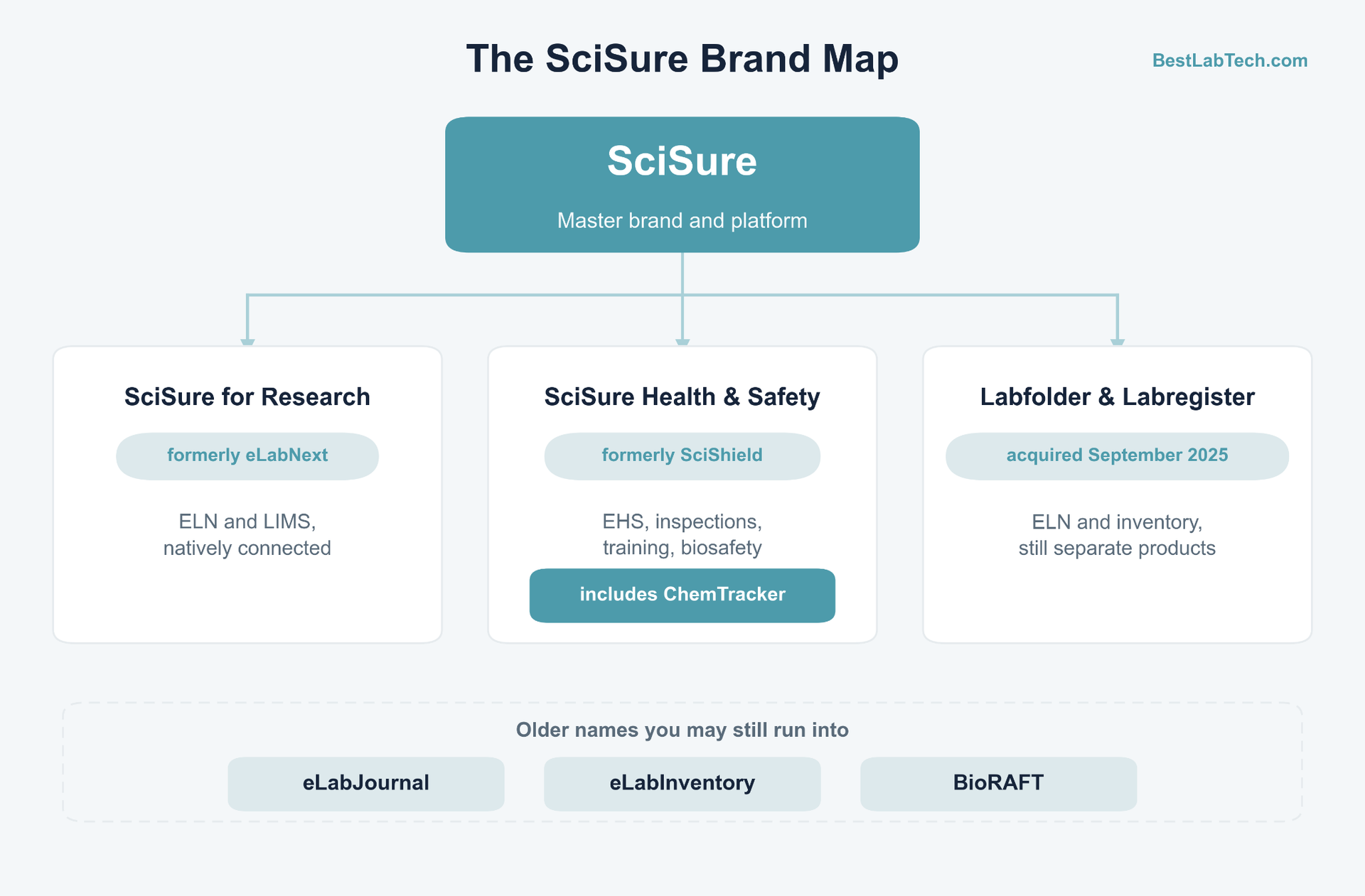
Several brands have been acquired by SciSure:
- SciShield, founded in 2003, did lab safety and compliance. eLabNext, founded in 2010, did research documentation. In January 2025 they merged to form SciSure.
- Then in September 2025, SciSure acquired Labfolder and Labregister from Labforward.
- Other names that are now part of SciSure include eLabJournal, eLabInventory, eLabProtocols, BioRAFT and ChemTracker.
These acquisitions are summarised in the brand map below.
SciSure’s support centre publishes a starter guide for Labfolder users covering what to review after migration.
SciSure Is Two Platforms Under One Brand
ELN and LIMS are natively connected. Experiments link to samples and samples link to inventory.
Health & Safety is a different environment, with separate login and separate hosting. The table below shows how each is deployed.
| ELN and LIMS | Health & Safety | Updates | |
| Shared cloud | Yes | No | Continuous |
| Private cloud | Yes | Yes | Quarterly, staging included |
| On-premises | Yes | No | Quarterly, staging included |
Table 3: SciSure deployment matrix, verified against SciSure’s hosting page, August 2026
SciSure’s own hosting page states that Health & Safety capabilities are “only available on Private Cloud hosting.”
That carries cost and update-cadence consequences, and it rules out shared cloud and on-premises entirely for anyone who needs EHS.
One G2 reviewer wrote that the separation between Journal, Inventory and Protocol products means “each requires a separate login, which can be inconvenient and time-consuming.”
The SciSure questionnaire also states that Health & Safety is “part of the same platform strategy” while acknowledging that “current login and hosting information still distinguishes the Research and Health & Safety environments.”
Who SciSure Is Built for and Who Should Skip It
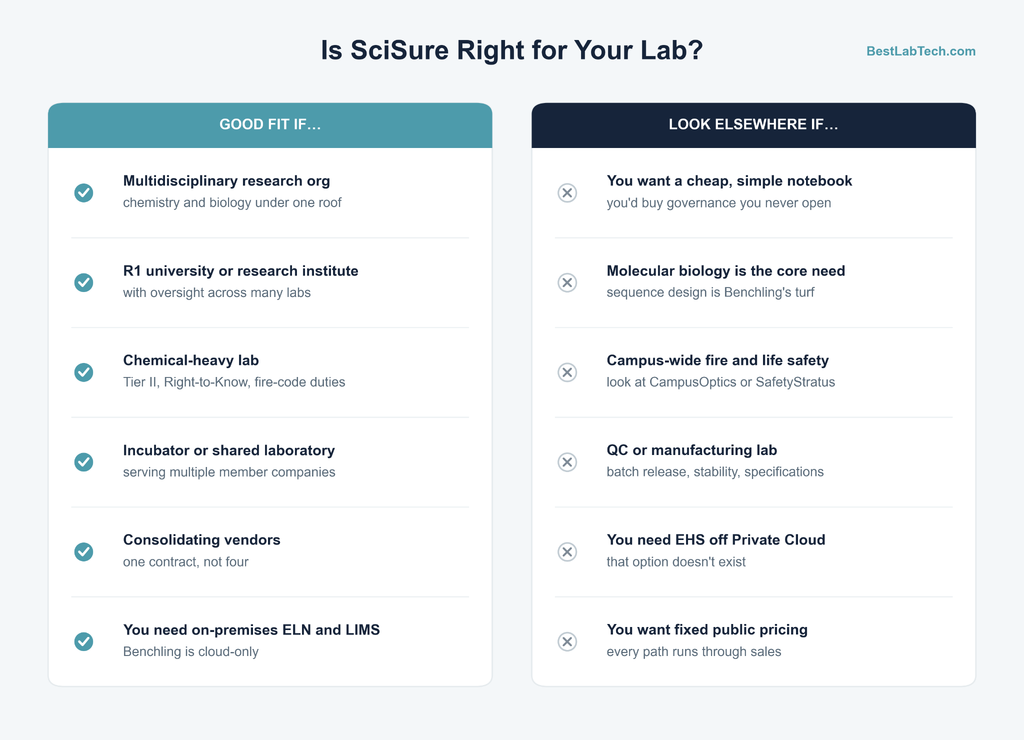
Good fit if you…
- Run a multidisciplinary research organisation
- Are an R1 academic institution or research-intensive university with real institutional oversight obligations across many independent labs
- Operate a chemical-heavy lab with Tier II, Right-to-Know, fire-code or Maximum Allowable Quantity reporting duties
- Run an incubator or shared laboratory supporting multiple member companies, where organisation-wide chemical inventory and safety oversight is the core problem
- Are actively consolidating vendors across scientists, LabOps, EHS and IT, and want one contract instead of four
- Need on-premises ELN and LIMS. One of SciSure’s biggest competitors is Benchling, which is cloud-only.
Look elsewhere if you…
- Just want a cheap, simple notebook
- Are a molecular biology organisation whose defining need is sequence design and a biology-aware registry
- Need campus-wide facilities, fire and life safety, maps and emergency pre-plans beyond research labs. Look at CampusOptics or SafetyStratus
- Run a QC or manufacturing lab needing batch release, stability programs, specifications or environmental monitoring
- Need Health & Safety on shared cloud or on-premises. It doesn’t exist. See the table above.
- Want fixed public pricing and a self-serve purchase
Key Features That Matter
| Feature Area | What It Does Well | Limitation | Bottom Line |
| ELN | Experiments, templates, protocols, version control, audit trails and electronic signatures, natively linked to sample records | Real-time co-editing is weak; reviewers report needing to save and close before colleagues see changes. Protocol imports often lose source formatting | Solid, structured documentation. Not a live collaborative canvas |
| LIMS | Sample and specimen tracking, custom sample types, lineage, storage, equipment, barcoding and lab workflow software automation | Bulk operations are the recurring gap. Editing many samples at once, or attaching multiple files, is tedious | Strong tracking core, weak on batch actions |
| Health & Safety | Inspections, incidents, corrective actions, training, biosafety, hazardous waste, radioisotopes and medical surveillance | Private Cloud only, separate login from Research | The most differentiated half of the platform, behind a deployment wall |
| Integrations | 40+ marketplace add-ons, open API and developer SDK. Named partners include Protocols.io, Nikon NIS-Elements, DYMO LabelWriter, Eppendorf VisioNize Sense, Box, Dropbox and Google Drive | “Most add-ons are free, while some premium integrations require a subscription.” Availability varies by product and hosting model | Good breadth. Confirm your specific integration is included at your tier |
| Search and navigation | Keyword search across experiments, samples and inventory | The single most common complaint theme in the reviews. Users describe a dated interface and unclear tab structures | The weakest everyday experience |
| Compliance tooling | Audit trails, e-signatures, role-based permissions, version control, structured exports, backups and staging | Frequent cloud updates create revalidation work in regulated settings | Capable, but budget validation effort |
Table 4: SciSure key features, August 2026
Navigation is where the reviews are most consistent, and they’re blunt about it.
One G2 reviewer described the interface as “really bland and feels like it was made in 2008,” adding that “the sidebar and navigation systems are not very intuitive.“
Another flagged the file-handling specifically: attaching files to a sample means uploading them one at a time, because the system “doesn’t remember what folder I was in, and doesn’t let me select and upload multiple files at the same time.”
For regulated labs, the sharpest criticism is about update cadence. One reviewer put it directly: “each software change requires revalidation to ensure continued compliance with regulatory requirements. This adds significant time, documentation effort, and operational burden, even when the updates are minor or non-critical.”
ChemTracker: The Feature Competitors Don’t Have
ChemTracker is the strongest argument for choosing SciSure over anyone else.
ChemTracker was built at Stanford University and run as a higher-education consortium for chemical inventory and reporting. BioRAFT, later SciShield, licensed the brand and IP from Stanford in March 2017 and built it into its platform.
It’s the chemical inventory and chemical intelligence module inside SciSure Health & Safety.
SciSure’s product page describes:
- Container-level tracking in real time
- Barcode and RFID scanning for logging and retrieval
- Automatic SDS attachment to containers, driven by a proprietary chemical property database
- Integrated SDS management
- Reports “in the required units, including Tier II RTK, Fire Code compliance, and Maximum Allowable Quantities (MAQ’s)”
- Reporting by control area or floor, with hazard class assignments built in
SciSure also told me the module includes ChemSnap, an AI-assisted label-capture tool.
SciSure’s published SmartLabs customer story reports inventory searches dropping from around 15 minutes to 1 to 2 minutes, a full research-centre reconciliation completing in roughly 20 minutes instead of a full day, and inventory reports falling from about 30 minutes to one.
How Much Does SciSure Cost?
SciSure doesn’t publish its pricing anywhere.
But they do say that pricing is subscription-based, per-user and quote-led.
And the final number depends on products selected, user count, hosting model, implementation, migration, integrations, validation, number of sites, and support level.
Most lab software brands don’t publish pricing, so this isn’t a major problem. (QBench is a great example of a vendor that does. Check out our Qbench review if you want more information.)
What’s publicly known is thin but useful. G2’s pricing page indicates separate academic, industry, and startup bands. SciSure also runs a Startup Program offering discounted pricing and personalised onboarding.
One reviewer named the affordability problem directly, noting that while large academic and enterprise institutions get high ROI, “justifying the initial deployment and recurring licensing fees can be a hurdle for smaller organizations operating on tight budgets.”
And there’s a 30-day free trial covering experiment, sample, inventory and protocol management, which is ELN and LIMS. Health & Safety isn’t stated as included, so don’t assume it is. A pre-populated demo account is also available.
What to ask on the sales call:
- What’s the Private Cloud uplift versus shared cloud, given EHS requires it?
- Which of my required integrations are free add-ons, and which need a separate subscription?
- What’s quoted for implementation, migration and validation support, separately from licences?
- What’s the renewal escalation clause, and what’s the cap?
- If I’m a Labfolder or Labregister customer, how does the process work?
- What does a Health & Safety trial or proof of concept look like, since it’s outside the standard 30-day trial?
What Implementation and Support Look Like
G2 reviewers report an average implementation of around three months and roughly eight months to return on investment.
Those are reviewer-reported averages that G2 calculates from survey responses, not a vendor commitment, and SciSure itself notes that multi-site, validated, integrated or EHS deployments need individual scoping.
Support is the strongest number in the reviews. On Software Advice, customer support scores 4.5/5, the highest of the four rated categories, ahead of ease of use (4.2), value for money (4.3) and functionality (4.1).
For enterprise scale, SciSure’s published Institut Pasteur story is a useful reference. The institute evaluated more than 20 ELN and lab sample tracking software, narrowed seven formal contenders to two proofs of concept, involved scientists from around 50 units, and rolled out in four deployment waves.
On throughput, SciSure’s Boston University story describes an internal testing laboratory processing more than 5,000 samples per day, peaking above 9,000, with integrations to testing robots and two electronic medical record systems.
SciSure Pros and Cons
Pros
- The only vendor offering first-party ELN, LIMS and laboratory EHS with regulatory chemical intelligence under one contract
- ChemTracker’s Tier II, Right-to-Know, fire-code and Maximum Allowable Quantity reporting is specialist work and hard to replace
- Deployment choice for ELN and LIMS, including on-premises, which rules Benchling out for some buyers
- Strongest rated category is customer support at 4.5/5
- Ease of use is the dominant praise theme across the reviews
- 40+ marketplace integrations plus an open API and developer SDK
- Straight answers from the vendor about the platform’s actual current state
Cons
- Health & Safety runs on Private Cloud only, which constrains the whole unified-platform argument
- Research and Health & Safety are still separate environments with separate logins
- No published pricing anywhere, so no benchmarking before a sales cycle
- Navigation and interface friction is the most common complaint in the reviews
- Real-time collaborative editing doesn’t work the way modern users expect
- Continuous cloud updates create revalidation burden for regulated labs
- Four-brand history creates real confusion about what you’re actually buying
Top SciSure Alternatives
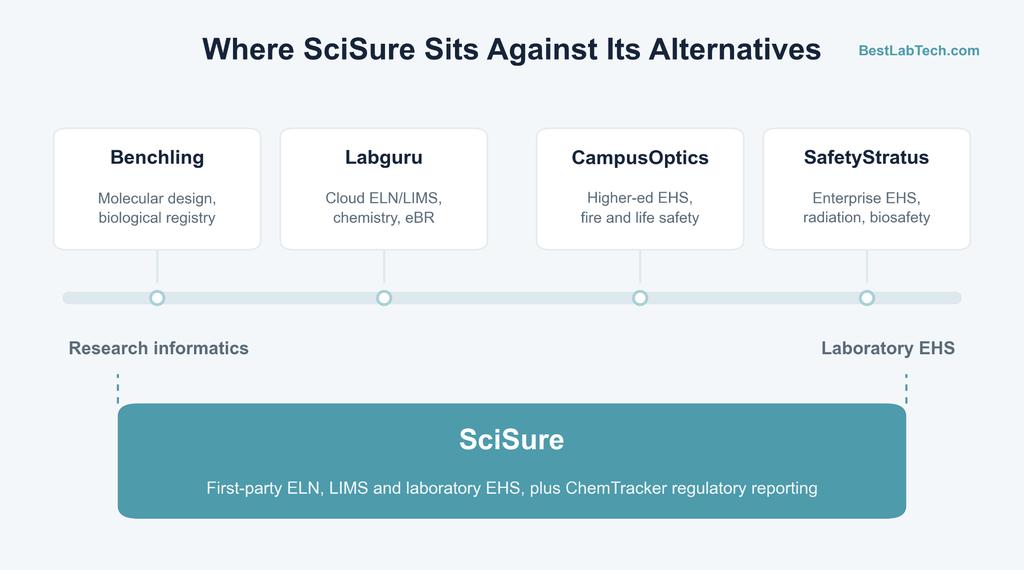
Two of these lab information management systems compete on research informatics and two compete on EHS, which tells you something about how unusual SciSure’s position is.
The four main alternatives are:
- Benchling for biology-first R&D
- Labguru by Cenevo for chemistry-heavy R&D wanting validated cloud
- CampusOptics for higher-ed institutional safety
- SafetyStratus for enterprise EHS breadth
1. Benchling: for biology-first R&D
Molecular design, biological registry, ELN, LIMS and inventory built around biology-aware data models. If sequence design and a biological registry are your defining needs, Benchling is probably your best bet.
The trade-off: it’s cloud-only, and there’s no first-party lab EHS suite.
2. Labguru by Cenevo: for chemistry-heavy R&D wanting validated cloud
Cloud ELN/LIMS with inventory, equipment, chemistry, lab automation, dashboards, validated cloud and electronic batch records. A close functional overlap with SciSure Research.
The trade-off: sample management sits largely in Mosaic, a separate product under the same brand, offered as partially integrated.
3. CampusOptics: for higher-ed institutional safety
Higher-education EHS, fire and life safety, mobile inspections, assets, campus maps, emergency pre-plans, permits, incidents and training.
The trade-off: no first-party research ELN or LIMS. If your problem is campus-wide safety rather than research documentation, this is the more natural fit.
4. SafetyStratus: for enterprise EHS breadth
Broad, configurable enterprise EHS spanning chemicals, inspections, incidents, training, radiation, biosafety, waste, occupational health, auditing and ESG.
The trade-off: same structural gap. Deep EHS, no research platform underneath it.
None of the four advertises the same first-party combination of ELN, LIMS, laboratory EHS and chemical regulatory intelligence.
If you need all four, SciSure has you covered.
If you need one of them done exceptionally well, a specialist will probably beat it.
The Bottom Line: Should You Buy SciSure?
Buy SciSure if…
- You’re a multidisciplinary research organisation, R1 institution, incubator or chemical-heavy operation that needs research documentation and laboratory safety compliance
- You’re willing to run on Private Cloud, and consolidating four vendors into one contract is worth real money to you. ChemTracker alone justifies the shortlist spot if you have regulatory chemical reporting duties.
Hold off if…
- You need Health & Safety on shared cloud or on-premises
- Your defining need is molecular biology
- You need firm budget numbers before a sales process
Fastest way to decide: Book a demo, and insist on seeing the actual cross-platform workflow you care about, on the hosting model you’d buy.
Then have a few real users run a normal week’s tasks in the 30-day trial. Ease of use is this product’s most praised quality and navigation is its most criticised, which means the answer depends on your team.
Thanks for reading! For more independent lab software reviews like this one, check out our Benchling review and our Labguru review. And we can help you get matched to the right lab software.
Frequently Asked Questions About SciSure
Is SciSure the same as eLabNext and SciShield?
Yes. SciSure is the current master brand, formed in January 2025 when eLabNext and SciShield merged. eLabNext products are now SciSure ELN and SciSure LIMS, and SciShield is now SciSure Health & Safety.
Legacy names you may still encounter include eLabJournal, eLabInventory, BioRAFT and ChemTracker. In September 2025 SciSure also acquired Labfolder and Labregister from Labforward.
How much does SciSure cost?
SciSure doesn’t publish pricing. It sells subscription, per-user licences priced by quote, with the total depending on modules, users, hosting model, implementation, migration, integrations, validation and number of sites.
G2 indicates separate academic, industry and startup bands. A discounted Startup Program is also available.
Does SciSure have a free trial?
Yes. SciSure offers a 30-day free cloud trial covering experiment, sample, inventory and protocol management, which is the ELN and LIMS side. A pre-populated demo account is also available.
Health & Safety isn’t listed as part of the standard trial, so ask specifically if you need to evaluate it. There’s no evidence of a permanent free tier.
Are SciSure’s ELN and Health & Safety really one integrated platform?
Partly. ELN and LIMS are natively connected to each other. Health & Safety is part of the same platform strategy but still runs as a separate environment with its own login, and SciSure’s hosting documentation confirms it’s available only on Private Cloud.
Ask for a live demo of the specific cross-platform workflow you need.
What’s happening to Labfolder and Labregister?
Both were acquired by SciSure from Labforward in September 2025 and now operate under the SciSure brand, with Labfolder keeping its own website and trial process for now.
Is SciSure 21 CFR Part 11 compliant?
SciSure provides features that support 21 CFR Part 11 requirements, including audit trails, timestamps, electronic signatures, role-based permissions and version control. No software is “Part 11 compliant” on its own. Compliance depends on your intended use, configuration, procedures, training and your own validation work.
How We Reviewed SciSure
210 SciSure reviews were scraped from G2 in August 2026, coding every “what do you dislike” and “what do you like best” answer by theme so the pros and cons here reflect counted frequency rather than impression. I also scraped the 100-review Gartner Digital Markets pool shared across Capterra, Software Advice and GetApp.
Product facts were verified against SciSure’s own platform, hosting, integrations, trial and company pages, plus its Trust Center. Ownership and acquisition details were checked against acquisition announcements and the private equity sponsor’s own releases.
SciSure’s team also answered a written questionnaire for this review.