

Roughly 60% of commercial lab information management system (LIMS) deployments fail to deliver their original requirements. Often, this has nothing to do with the vendor or the product. Usually it’s because labs automate workflows they had never properly documented.
The fix is unglamorous and it happens before any demo gets booked:
- Map your actual process
- Clean your data
- Define what you need from how your lab really works
This article explains why that sequence matters and what to do about it. And don’t forget to check out our review of the best lab management software.
But before we continue, subscribe to our newsletter. Every week, we send a curated list of the most useful resources, tools, and reads from across the lab tech world. Enter your email below to subscribe.
Lab Information Management Systems: The Scale of the Problem
LIMS implementations fail in remarkably consistent ways, regardless of lab size, sector, or vendor.
The figure cited in the first sentence (60% of deployments failing to meet original requirements) lines up with general IT project data, where about two-thirds of major projects miss budget, schedule, or scope, and at least a third are written off as outright failures by the teams running them.
The money involved makes this expensive to get wrong. Implementation projects typically run from £150,000 to £1,500,000. In 2026, cloud-based LIMS pricing sits between $40 and $300+ per user per month, while on-premise deployments demand $50,000 to $250,000+ upfront plus annual maintenance.
The line item that consistently blows up isn’t the licence. It’s the implementation effort, which routinely dwarfs the software cost.
And these failures are not primarily technical either. A working LIMS is genuinely transformative, it automates sample tracking, enforces standardised workflows, kills transcription errors, and builds audit-ready data trails. The capability is real and it’s mature.
What breaks is the transfer of a half-documented, inconsistently-followed manual process into a digital system that demands precision your lab never had in the first place.
The Multiplier Effect: Software Amplifies what Already Exists
I used to work as an electron microscopist. In the lab, my boss would always say, “shit in, shit out” in regards to microscopy results. In other words, the quality of your images and analysis is only as good as your sample prep.
It’s a useful analogy for LIMS implementations.
Your LIMS and automation will only be as good as your lab process. If you have bad processes or bad lab data then you’ll only automate these bad processes at scale.
Or as Rod Michael said, “If you automate a mess, you get an automated mess”.
The single most useful way to think about LIMS failure is as multiplication, not addition. A good process multiplied by good software gives you a transformative result. But a broken process multiplied by the same software gives you a faster, more expensive, more entrenched version of the original mess (see the image below).
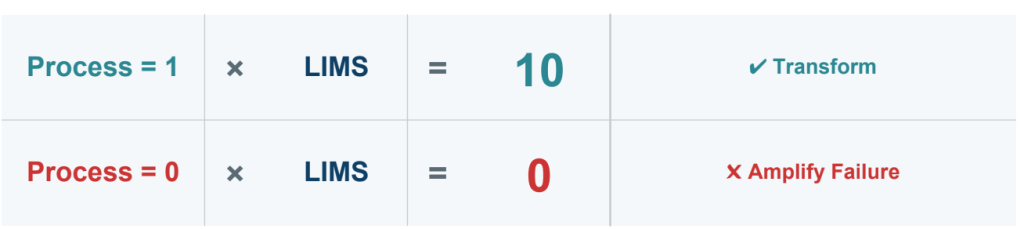
Figure 1: Automate a solid lab process (Process = 1) with a LIMS and you get transformation. Automate a poor lab process (Process = 0) and you amplify failure.
A LIMS doesn’t fix disorganised sample IDs, free-text diagnosis fields, or inconsistent naming conventions. It locks them in at the database level, where they become far harder to correct than they were on a whiteboard.
One r/labrats thread on Reddit laid out a data environment where corrections had to be propagated across every result file by hand, sample IDs drifted between systems (dashes quietly becoming underscores), and a single diagnosis column held hundreds of unique free-text variants instead of a controlled vocabulary. Drop a LIMS on top of that and you don’t resolve the inconsistency. You institutionalise it.
Bottom line: don’t buy a LIMS to fix your data. Fix your data, then buy a LIMS.
The Six Core Failure Modes
LIMS projects fail through a recognisable set of patterns. They tend to compound, which is why a project rarely fails for one tidy reason. The table below summarises the six core ways LIMS projects fail.
| Failure Mode | Frequency | Primary Impact |
| Automating an undocumented / messy process | Very High | System reflects dysfunction at scale |
| Scope creep | High | Budget and timeline overruns |
| Poor user adoption / change management | High | Data quality degradation post go-live |
| Integration complexity | High | Data silos, manual re-entry, compliance gaps |
| Data quality / legacy migration | Moderate–High | Corrupted records, audit failures |
| Regulatory / validation burden | Moderate | Delayed go-live, post-approval re-work |
Table 1: Summary of six core LIMS failure modes.
Let’s outline these one at a time:
1. Automating an undocumented or messy process
Labs buy before they’ve documented, audited, or optimised their own workflows. There’s a persistent gap between what lab managers believe happens on the floor and what actually happens. And process mapping, documenting the real as-is workflow before any software is selected, is the single most important pre-LIMS activity you can do.
As one r/medlabprofessionals contributor on Reddit put it, the deeper issue behind “LIMS being built by developers rather than people who have worked in a lab” is that the lab’s own process was never rigorously defined before configuration began.
2. Scope creep
Labs buy on reputation, rush to implement current requirements, and never account for future needs or edge cases. A six-month, £200,000 project quietly becomes a twelve-month, £500,000 one.
The defence is a minimum viable product approach: ship something functional, learn from it, extend in controlled phases, and apply formal change control to anything added after sign-off.
3. Poor user adoption
As one implementation guide bluntly admits, new LIMS deployments often suck at first and nearly everyone is primed to hate the new system.
Resistance builds because your current practices suddenly feel scrutinised. Also, master-data harmonisation surfaces arguments people had been avoiding for years. And training eats bench time that staff see as low-value. One r/biotech comment on Reddit named the real cost as “unlearning of previous tasks that do not directly translate to the LIMS.”
4. Integration complexity
Integration is consistently the hardest and most expensive part of any implementation, and the part most underestimated at the RFP stage.
A LIMS has to exchange data with instruments, ELNs, ERP systems, EMRs, QMS platforms, and partner systems.
The normal state for any organisation that grew through acquisition or across sites is exactly what one practitioner described: manufacturing and pharma-sci teams running different LIMS versions with no cross-talk, forcing one team to wait on another for batch-release results.
5. Data quality and legacy migration
Inconsistent formats, free-text fields that resist normalisation, instrument-specific structures, and decades of records a regulator can request at any time all converge here. Labs that skip a pre-migration data audit discover the problem only once configuration is underway, which is the most expensive possible moment to find it.
6. Regulatory and validation burden
FDA 21 CFR Part 11 requires trustworthy electronic records and signatures, with specific demands for validation, audit trails, signature controls, and retention. IQ/OQ/PQ protocols must be finished before go-live. And any later configuration change has to be re-validated — meaning a configuration error caught after QA approval can delay dependent milestones by weeks.
What the Lab Community Actually Says
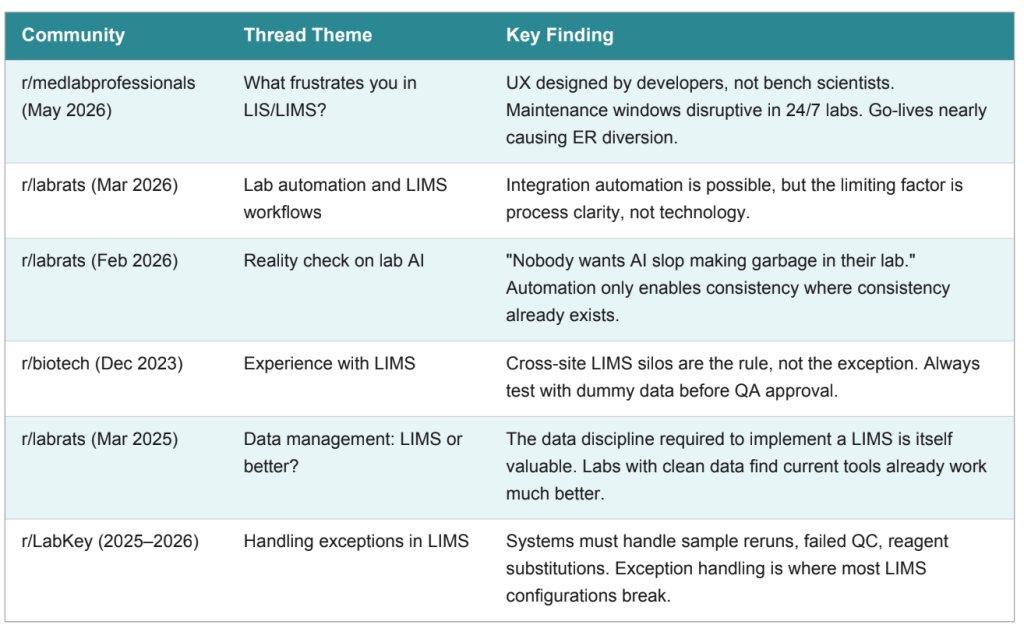
Table 2: Summary of lab community comments on Reddit.
Reddit communities — r/labrats, r/medlabprofessionals, r/biotech, r/sysadmin, r/bioinformatics — are useful because they’re unfiltered by vendor messaging. The table above summarises the main themes of a few of these communities.
Across threads active through 2024–2026, the same complaints recur:
- UX designed by developers rather than bench scientists
- Maintenance windows that are disruptive in 24/7 labs
- Cross-site silos treated as the rule rather than the exception
- A hard-won insistence on always testing with dummy data before QA approval.
Take a look at this observation: A 2025 r/labrats thread on data management noted that the discipline needed to implement a LIMS is valuable in its own right. Labs that clean up their data often find their existing tools start working far better.
The limiting factor is rarely the technology; it’s whether the process being automated is worth automating in the first place.
The Process-First framework: Four Steps Before You Buy
The framework is four concrete steps that should precede any procurement.
Step 1 — Map the actual process, not the ideal one
Observe real workflows, not SOP documents. Capture every exception and workaround. The goal is to find the gap between documented processes and lived reality, then close it before a single requirement is written. Done well, process mapping reveals redundancy, unnecessary loops, and undocumented decision points no one had formally recorded.
Step 2 — Standardise and clean your master data
Test names, sample types, methods, specifications, and naming conventions must be consistent across teams before configuration begins. This is the hardest cultural step because it forces cross-department agreement on conventions people have independently evolved for years. But it pays off independent of the LIMS: a lab with clean master data is simply easier to manage and audit.
Step 3 — Define requirements from the process, not the demo
Requirements should flow from your process map and master-data inventory, with input from every functional group, including bench scientists, QA, IT, data management, and regulatory. Treat the requirements checklist as a selection filter, not a post-decision justification.
Step 4 — Plan the change, not just the installation
A go-live is an organisational change event. The plan needs a communication strategy explaining what the system means for each role, role-based training tied to real workflows, named power users who champion adoption, and a fast feedback loop. Labs that treat go-live as a cutover date rather than the start of an adoption journey consistently see data quality degrade in the first three to six months.
Why 2026 Makes this Harder
Several current trends are amplifying these challenges rather than easing them.
- The LIMS is expected to act as a lab orchestration platform. This is the central hub coordinating instruments, ELNs, MES, ERP, and external data in real time. That raises the integration stakes of every project. If a lab can’t articulate its sample flow on a whiteboard, it isn’t ready to configure an orchestration platform.
- API-first transition is a genuine improvement. APIs are more flexible than point-to-point middleware, but it transfers more integration design responsibility to the lab. Poorly defined data models face a steeper learning curve here.
- AI feature pressure is intense, with vendors competing on predictive analytics and automation. The practitioner consensus is firmly sceptical: smart features applied to disorganised data don’t produce intelligent insights, they produce confident-sounding wrong answers. Get data accuracy and stable exception handling working before bolting on an analytics layer.
- Cloud migration now accounts for over 55% of the market, bringing format migrations, access re-provisioning, and vendor-managed update cycles. Even cloud systems can impose multi-hour maintenance windows, unacceptable in 24/7 clinical settings. So process continuity planning for when the LIMS is unavailable has to be designed in advance.
The Framework in Practice
This article isn’t an argument against LIMS. The market is growing at 13% CAGR precisely because well-implemented systems transform lab operations. The argument is that sequence matters: process clarity precedes selection, which precedes configuration, which precedes go-live.
- Map your actual process before you write a single requirement.
- Clean your data before you configure a single field.
- Define what you need from the process, not from the vendor demo.
- Plan the human change as rigorously as you plan the installation.
- Software is a multiplier — make sure you have something worth multiplying.
If you found this article helpful, check out our white paper, Why LIMS Implementations Still Fail in 2026: The “Process First” Manifesto, for a more in-depth look at why LIMS projects fail despite advances in technology, and how you can avoid making the same mistakes.
You can also subscribe to our newsletter. Every week, we send a curated list of the most useful resources, tools, and reads from across the lab tech world. Enter your email below to subscribe.